
France World Cup 2026: Schedule, Fixtures & Preview
By Jack Brown · ·
Why the France national football team are among the 2026 World Cup favourites
France at the 2026 World Cup — quick facts: Group I · Opponents: Senegal, Iraq, Norway · Coach: Didier Deschamps · Captain: Kylian Mbappé · FIFA ranking: 2nd · World Cup appearances: 16th · Best result: Champions (1998, 2018) · Runners-up (2006, 2022). France opened their Group I campaign on 16 June with a 3–1 victory over Senegal.
This page covers the france national football team at the 2026 FIFA World Cup. France arrive in North America as the second-ranked team in the world and the most decorated side in recent tournament history — World Cup winners in 1998 and 2018, runners-up in 2006 and 2022. Drawn into Group I alongside Senegal, Iraq and Norway, the france world cup group stage runs from to , with a draw that offers a clear path to the knockout bracket for Didier Deschamps' squad. Kylian Mbappé captains the side at Real Madrid having just completed his first Champions League season at the Bernabéu, while Marcus Thuram, Aurélien Tchouaméni and a generation of players drawn from Europe's elite clubs give France one of the deepest squads in the tournament.
The narrative around France in 2026 is shaped by two consecutive near-misses: a 2022 World Cup final in Qatar lost on penalties to Argentina after a comeback from two goals down that still ranks among the most remarkable passages of play in recent tournament history. That defeat — arriving after Mbappé's hat-trick in the final itself — gave France the quality metrics of a champion in circumstances that delivered a runner-up medal. It is the specific character of that loss that defines what 2026 means to this group. They know they can perform at the highest level in the highest-pressure situations. The unresolved question is whether the tactical and squad adjustments Deschamps has made since Qatar can carry a team that has already been to three of the last four finals all the way to a third World Cup title.
What are France's group stage fixtures at the 2026 World Cup?
France's three group stage matches in 2026 span ten days and offer two fixtures that the squad should win comfortably and one that carries genuine competitive weight. The opening fixture on is against Senegal — Africa's highest-ranked side and a team packed with European-based talent from the Premier League, Ligue 1 and the Bundesliga. Senegal are not an easy opponent: they won the Africa Cup of Nations in 2022, qualified for the 2022 World Cup round of 16 and have a squad capable of absorbing pressure and punishing transitions. The individual quality gap between the two squads is significant, but the match carries the kind of opening-fixture pressure that has disrupted France campaigns before. The second group match, on , is against Iraq — a side from the Asian qualification route whose collective quality falls well below the level of their Group I opponents. France are expected to win this match efficiently.
The group decider, on , is against Norway — a significantly more testing proposition than Iraq and potentially a match that determines group position rather than qualification. Norway have developed into a technically accomplished European side around the Haaland generation, and their combination of aerial threat, pressing intensity and counter-attacking speed makes them a different physical challenge to the opponents France have managed in recent tournaments. Six points from the first two matches would allow Deschamps to use the Norway fixture strategically, rotating key players and managing physical load for the knockout phase. If France drop points against Senegal, the Norway match becomes a high-stakes group decider with real consequences for bracket positioning.
France's france world cup fixtures draw is not as open as the 1998 or 2018 group stage formats delivered, but it is considerably more manageable than the 2022 draw in Qatar — where Les Bleus faced Denmark twice and still navigated a path to the final. The Group I opponents collectively rank far below the calibre of previous French group stage opponents over the last three editions. The realistic expectation is maximum points from the group, with the broader tournament conversation shifting immediately to who France face in the round of 32 and the round of 16.
How does Didier Deschamps want France to play at the 2026 World Cup?
Didier Deschamps has managed the france national football team since 2012 and his tactical philosophy is one of the most discussed and sometimes most controversial in European football: a system built on defensive solidity, controlled possession transitions and the protection of the attacking talent at the top of the pitch. Critics have consistently argued that French players — individually among the most gifted in any generation of European football — are underused in a system that prioritises team compactness over individual expression. Supporters of Deschamps point to the results: a World Cup title in 2018, a final in 2022, consistent deep runs in every major tournament since 2014 with the exception of a dismal 2021 European Championship group stage exit.
The preferred formation in 2026 is a 4-3-3 that collapses to a 4-5-1 without the ball. N'Golo Kanté, if fit, anchors the midfield with a defensive role that frees Aurélien Tchouaméni and Eduardo Camavinga or Warren Zaïre-Emery to operate with more vertical ambition. The full-backs — Theo Hernandez on the left and a right-back from the options of Benjamin Pavard and Jules Koundé — are expected to provide width and create overloads in combination with the wide forwards. The attacking structure is built to serve Kylian Mbappé, who occupies the left side of the front three or the central striker position depending on the opponent and in-game state. When Mbappé drifts left, space opens centrally for a runner, typically Marcus Thuram or Ousmane Dembélé, whose movement creates the chaos France rely on to generate high-quality chances at pace.
Defensively, the structure is anchored by Dayot Upamecano and Ibrahima Konaté at centre-back — a pairing that brings aerial dominance and positional discipline from the Premier League and Bundesliga. Mike Maignan in goal is among the technically best ball-playing goalkeepers in world football, capable of contributing to possession sequences under pressure. What Deschamps has built is a team that does not concede individual quality to opponents — every position carries an elite performer capable of decisive moments — but that also functions as a collective unit capable of grinding out results when the attacking phase is not producing. This is why France have consistently reached the later stages of tournaments even in matches where they have not played well. Their floor is significantly higher than almost any other team at this World Cup.
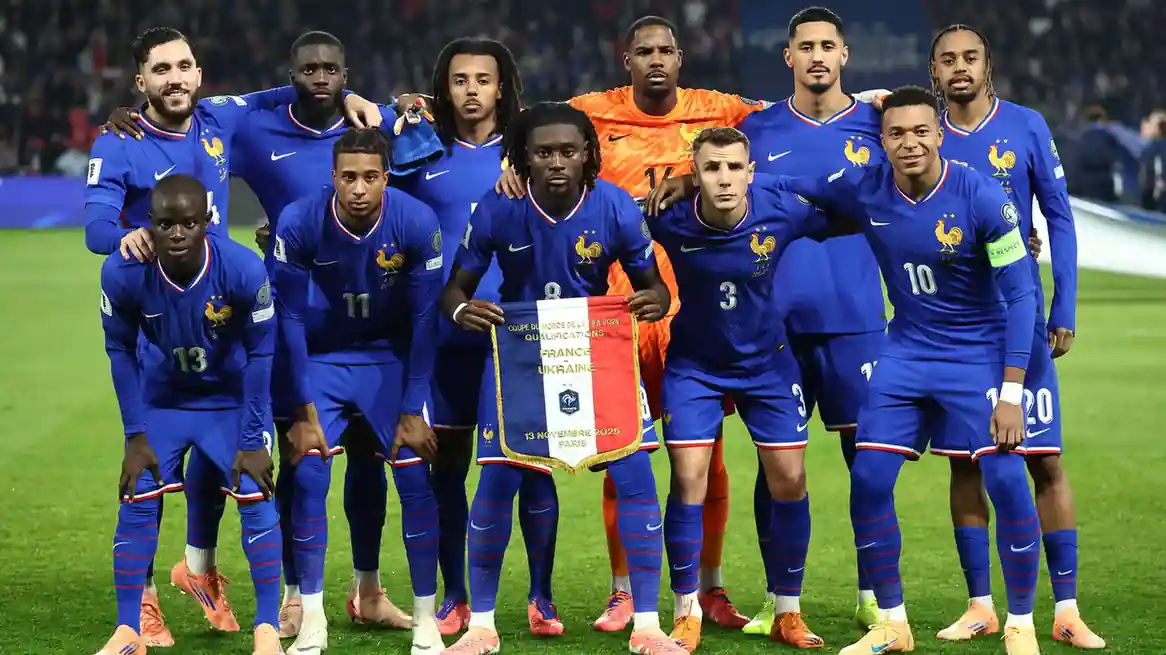
Which France national football team players should you watch at the 2026 World Cup?
Kylian Mbappé is the most scrutinised player at the 2026 World Cup after the events of the 2022 final in Qatar. He scored a hat-trick — including two goals in the final three minutes of normal time — as France came back from 2-3 down before eventually losing to Argentina on penalties. That performance placed him in a category reserved for the greatest individual performances in World Cup final history, yet the medal he received was silver. At Real Madrid since 2024, Mbappé has developed the positional intelligence his club career demanded: a more patient, space-creating version of the instinctive acceleration machine that defined his breakout at the 2018 World Cup. At 27, he arrives in North America at the precise peak of his physical and technical capacities, carrying the specific motivation of a player who has been to a World Cup final and left without the winner's medal. His ability to create chances from wide positions, to run in behind stretched defensive lines and to convert under goalkeeper pressure from inside the box makes him the single most dangerous attacking player in the tournament.
Marcus Thuram has developed from a promising talent into one of the most complete strikers in European football over the last three seasons at Inter Milan, where he finished as the club's top scorer in their 2024–25 Serie A campaign. At 27, Thuram combines his father Lilian's defensive awareness and reading of the game with a physicality and technical touch that creates problems for centre-backs who expect a striker to either hold the ball up or run in behind — Thuram does both within the same attacking sequence. For France at the 2026 World Cup, Thuram's movement between the lines, his ability to combine with Mbappé in one-two situations and his capacity to score from range or from headers make him a different type of threat to any other forward in the squad. In the matches against Iraq and in the knockout phase against compact defensive teams, Thuram's ability to receive between the lines and play forward quickly is the mechanism through which Deschamps' system can break low-block defences.
Aurélien Tchouaméni is the midfielder who makes the current France system function at both ends of the pitch. The Real Madrid central midfielder has developed into one of the top three defensive midfielders in world football over the last two seasons — a player capable of intercepting passing lanes before they become chances, of winning physical duels against technically superior opponents and of distributing quickly with accuracy at the moment of transition. Tchouaméni's importance to France's defensive structure cannot be overstated: in the matches where he has been absent through injury or suspension, the gaps behind the French midfield have been exploited at a noticeably higher rate. His partnership with Kanté — if the veteran is available — or with Camavinga gives France a double pivot capable of dominating the midfield zone against any Group I opponent and maintaining that dominance into the knockout bracket.
What is France's World Cup history and how does it shape 2026?
France have participated in the FIFA World Cup on fifteen previous occasions, with the 2026 tournament marking their sixteenth qualification. For a country whose footballing identity was long defined by brilliant individual talent that could not be harnessed into collective tournament success, the modern era has been remarkable. From the 1998 World Cup — won on home soil with Zinedine Zidane scoring twice in the final against Brazil — through to the 2018 triumph in Russia and the 2022 final in Qatar, Les Bleus have been one of the three most successful nations in the tournament since the turn of the century. Only Brazil (five titles) and Argentina (three) have accumulated comparable results at the World Cup level since 1998, and neither has matched France's consistency in reaching the latter stages.
The 1998 World Cup win remains the foundational moment in modern French football. Hosting the tournament, France went into the final against Brazil as underdogs in reputation but clear favourites in form: Ronaldo's mysterious pre-match illness, Zidane's two headed goals from corners and a third from Emmanuel Petit in injury time produced a 3-0 victory that remains one of the most celebrated nights in French sporting history. The squad — Zidane, Deschamps as captain, Thierry Henry, Youri Djorkaeff, Marcel Desailly, Bixente Lizarazu — defined a generation. It is not incidental that the coach of the 2026 squad is the same man who captained that 1998 team as a holding midfielder: Deschamps carries the institutional memory of what a World Cup win requires and the personal motivation that comes from being the only person in French football history to have won the tournament as both player and coach.
The 2018 win in Russia produced a different type of triumph: a younger, faster, more physically dominant team that beat Argentina, Uruguay, Belgium and Croatia — each a top-ten side — across the knockout stage. Mbappé's pace, Griezmann's creativity, Pogba's energy and a defence built around Varane and Umtiti became the blueprint for a new generation. The 2022 final against Argentina in Qatar remains one of the most watched matches in World Cup history — a game France appeared to be losing until Mbappé's hat-trick created a comeback of extraordinary drama. The penalty shootout loss was devastating, but it also confirmed that this generation of French players can perform at the absolute highest level in the most pressured environments. The 2026 edition is the logical destination of everything that generation has built since 2018.
What is France's realistic path to the final at the 2026 World Cup?
France, as expected Group I winners, would face one of the best third-placed finishers from adjacent groups in the round of 32 — the new knockout phase introduced for the 48-team format. The projected bracket from Group I suggests France could face a third-placed side from Groups G, H or J, depending on how the group tables settle. This first knockout match is expected to be the most accessible fixture France face in the entire tournament, and Deschamps will likely treat it as an opportunity to manage the physical load of key players while still winning comfortably.
The round of 16 is where the tournament difficulty increases substantially. France's bracket in the upper half of the draw puts them on a potential collision course with sides from South America or from other European groups that include nations like England, the Netherlands or Spain — depending on where each finished in their respective groups. A quarter-final between France and England, or France and Brazil, is a realistic scenario that tournament analysts have projected as one of the most anticipated potential matchups in the 2026 format. These are the matches that will define the legacy of Deschamps' final World Cup as France coach — the last edition of a tournament run that began in 2014 and has produced a consistently elite level of performance across twelve years.
The semi-final and final bracket gives France the structural conditions to win the tournament. Their squad depth — the capacity to bring on Camavinga, Dembélé or Zaïre-Emery from the bench without a significant drop in quality — allows Deschamps to manage physical and tactical demands across seven matches in ways that most other squads cannot match. The core of the team that reached the 2022 final has four more years of elite experience, two of the squad's most important players (Mbappé and Thuram) are at the peak of their capacities, and the supporting cast from Real Madrid, Inter Milan, Bayern Munich and PSG gives Les Bleus a collective quality baseline that exceeds any previous edition of the tournament except perhaps the 2022 French squad itself. If France avoid a catastrophic injury to Mbappé and maintain their defensive baseline through the knockout rounds, the conditions are in place for a third World Cup title.
For the complete Group I schedule and results, see the full 2026 World Cup schedule and all 12 group stage draws.
FAQ
Can France win the 2026 World Cup?
France are joint favourites alongside Argentina for the FIFA World Cup. As two-time champions, ranked second in the world and with Kylian Mbappé at his peak, Les Bleus have the squad depth, coaching experience and tournament record to go all the way. Their Group I draw is accessible and the bracket offers a realistic route to the final.
What is France's biggest threat at the 2026 World Cup?
France's most significant vulnerability is the physical load of their key players across a compressed seven-match schedule. Injuries to Mbappé, Tchouaméni or Upamecano at any point in the knockout phase would disrupt the structural balance of Deschamps' system. The France national football team has historically struggled when forced into back-footed defensive situations against physically direct opponents — Norway in the group stage and potential quarter-final opponents from South America represent this specific challenge.
How has Kylian Mbappé performed at previous World Cups?
Mbappé became the second teenager to score in a World Cup final in 2018, when France beat Croatia 4-2 in Russia. In 2022, he scored a hat-trick in the final against Argentina — including two goals in the last three minutes of normal time — finishing the tournament as top scorer with eight goals. He has scored 12 World Cup goals across two tournaments, making him one of the most prolific World Cup scorers in history before the age of 28.
Who are France's key players to watch at World Cup 2026?
The three players who will most shape France's 2026 World Cup campaign are Kylian Mbappé (Real Madrid, captain and attacking focal point), Marcus Thuram (Inter Milan, the physical and technical complement to Mbappé's pace) and Aurélien Tchouaméni (Real Madrid, the midfield anchor who protects the defence and initiates attacking transitions). Supporting performances from Eduardo Camavinga, Mike Maignan and Warren Zaïre-Emery will determine how deep France can go.
How many times has France hosted the World Cup?
France have hosted the FIFA World Cup once — in . France won that tournament, beating Brazil 3-0 in the final at the Stade de France in Saint-Denis, with Zinedine Zidane scoring twice from corners and Emmanuel Petit adding a third in injury time. The 1998 edition remains the only World Cup France have hosted; no future hosting rights have been awarded to France.