Will Messi Play the 2026 World Cup?
·
Why the answer still points toward one more run
The honest answer to will messi play 2026 world cup is that FIFA still stops short of a formal guarantee, but almost every recent official signal points in the same direction. In March 2025, FIFA wrote that Messi was poised to take part in a record sixth World Cup. Then on 5 November 2025, FIFA reported that Messi had extended with Inter Miami until at least 2028 and said he was on track to represent Argentina at World Cup 26. As of 7 May 2026, that is the clearest public reading: not mathematically confirmed by a final squad list, but very much alive and moving in one direction.
Argentina's wider context strengthens that reading. FIFA's January 2026 team profile described Lionel Scaloni's side as reigning world and continental champions, and explicitly said they would be spearheaded by long-standing talisman Lionel Messi in their title defence. That matters because the conversation is not only about whether he can still play. It is about whether Argentina still see him as central to another serious attempt to keep the world cup trophy in Buenos Aires for one more cycle.
There is a practical side too. Messi no longer needs to answer the question through volume alone. The 2026 version of the tournament is larger, the travel load is heavier and Argentina are far deeper around him than they were in some earlier cycles. That means the smartest path is not necessarily for him to dominate every minute. It is to arrive healthy, selectively explosive and emotionally decisive in the matches that define the title defence.
That is why the phrase will messi play 2026 world cup still generates so much attention. Supporters are not really asking whether he can kick a ball at elite level. They are asking whether the player who finally lifted the world cup trophy in Lusail still has one more major tournament run in his body and mind. FIFA's recent coverage suggests the answer remains yes in principle, even if the final administrative confirmation can only come when Argentina submit their official squad.
So the most accurate conclusion right now is this: Messi has not publicly locked the door on 2026, FIFA's own reporting continues to place him on the road to the tournament, and Argentina are clearly building their defence of the crown with his presence in mind. Until something official changes, the balance of evidence still supports the idea that one more World Cup chapter is more plausible than not.
Why Did Messi Leave Barcelona?
Understanding the full arc of Messi's career matters because his journey from Barcelona to Inter Miami is what makes a sixth World Cup both possible and symbolic. Messi left Barcelona in the summer of 2021 — not by choice, but because La Liga's financial fair play regulations prevented the club from re-registering him even after he agreed to a 50 percent pay cut. The COVID-19 pandemic had collapsed Barcelona's revenues, and the club's wage bill far exceeded what La Liga's salary cap allowed. After 21 years at the club, Messi announced his departure in tears at a press conference in August 2021.
He spent two seasons at Paris Saint-Germain, then joined Inter Miami in July 2023, where his arrival transformed the club's profile and the visibility of football across North America. The Miami chapter is where the 2026 connection becomes practical — Messi extended his contract to 2028, confirmed he is training and competing at elite level on the continent hosting the next World Cup, and gave himself the physical platform to answer the will messi play 2026 world cup question with action rather than words.
Messi vs Ronaldo at the 2026 World Cup
No debate in modern football carries the weight of Messi versus Ronaldo, and the 2026 World Cup may represent the final moment those two names appear on the same tournament sheet. Messi turns 39 in June 2026. Ronaldo turns 41 in February 2026. Portugal have qualified for the tournament, and Cristiano Ronaldo has continued representing his country at the highest level. If both men make their respective squads, it would mark the sixth World Cup appearance for each of them — a number no outfield player has previously reached.
The contrast in their 2026 situations adds another layer. Messi arrives as part of the defending champions, with Argentina's entire tournament structure built around him at the centre. Ronaldo arrives chasing the one trophy that would complete a career defined by every other major honour. He won the European Championship in 2016, has broken scoring records at club and international level, and has come close at multiple World Cups — but the trophy itself has never been his. That gap is what makes the 2026 version of messi vs ronaldo a question about legacy rather than just individual performance.
Whether they share a stage again in the knockout rounds depends on the draw and how both teams perform. But the wider point is that 2026 is almost certainly the last World Cup either man will contest. Football very rarely offers this kind of natural closing chapter — two players who defined an era, both still present, both still relevant, competing in the same tournament that has always been the biggest measure of the sport. For anyone asking will messi play 2026 world cup, the answer carries extra weight precisely because of who is expected to be on the other side of that conversation.
Messi's Six World Cups: A Record Run in Numbers
The sixth World Cup is more than a personal milestone. No outfield player in the history of the competition has appeared at more editions, and the numbers Messi carries into the United States, Canada and Mexico are difficult to frame without superlatives.
Across his first five tournaments — Germany in 2006, South Africa in 2010, Brazil in 2014, Russia in 2018 and Qatar in 2022 — Messi scored 13 goals and built the most complete individual World Cup record the sport has produced. The starting point was 2006, when an 18-year-old came off the bench in Argentina's final group game against Serbia and Montenegro and scored. Two decades later, he is the captain of the defending champions and the only player Lionel Scaloni has publicly identified as guaranteed to make the final 26-man squad regardless of form or fitness concerns from the rest of the squad.
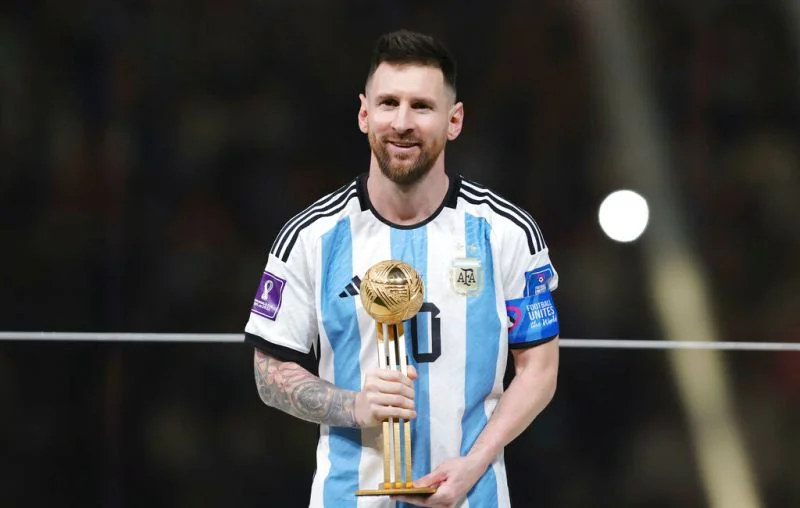
The 2022 chapter in Qatar is the one that changed the framing of everything that came before it. Seven goals, three assists, the golden ball for best player of the tournament and the winners' medal that had eluded him through four previous attempts. The decade-and-a-half of near-misses — the runner-up finish in 2014, the Copa América final losses, the single-goal campaigns in 2010 and 2018 — became origin story rather than failure. Qatar answered the question that had defined Messi's career. The 2026 version of the question is different: not whether he can win it, but whether he can do it twice.
Argentina's 2026 qualifying campaign added another statistical layer. Messi featured in 12 of Argentina's 18 CONMEBOL qualifiers and finished as the zone's top scorer with eight goals — a contribution rate that underlined his continued central importance to the team rather than a ceremonial late-career presence. That tally came despite the squad-management approach that kept him out of six qualifiers entirely. In the matches he played, he remained decisive. The data from South American qualification points in the same direction as everything else: he is not playing to close the chapter. He is playing to add to it.
Argentina's 2026 Group Stage: Group J and the Road to the Final
Argentina enter the 2026 World Cup in Group J alongside Algeria, Austria and debutants Jordan. The group schedule places them in three venues across the United States: Arrowhead Stadium in Kansas City for the opener against Algeria on June 16, AT&T Stadium in Arlington, Texas for the fixture against Austria on June 22, and a return to Arlington for the final group game against Jordan on June 27.
On paper it is a manageable group for the defending champions, and Argentina are widely expected to advance through to the round of sixteen with room to spare. The more significant conversations begin in the knockout stages, where the expanded 48-team format creates a longer path than previous tournaments. Winning in 2026 means staying fit and decisive through seven matches — a physical demand that is substantial for any player at 38 or 39, even one with Messi's recovery methods and tournament experience.
There is a personal dimension to the schedule worth noting. Messi turns 39 on June 24, 2026 — two days after Argentina's second group game against Austria. If Argentina advance deep into the tournament, he will be celebrating that birthday inside a World Cup knockout run. For a player who has spent almost his entire adult life building toward the moment in Qatar, the prospect of defending the title a year after turning 39 is either a fitting coda or a continuation of something that never really had a conventional endpoint.
How Fit Is Messi Heading Into the 2026 World Cup?
Fitness is the one variable that Scaloni cannot fully control, and it is the honest counterweight to all the institutional optimism surrounding Messi's 2026 involvement. Throughout 2025 and into early 2026, Messi dealt with recurring soft-tissue problems. A mild right hamstring strain in August 2025 kept him out of an Argentina international window. A left hamstring issue following a friendly in Ecuador in February 2026 caused Inter Miami to carefully manage his return to training, with the club declining to offer a specific return timeline while emphasising that the injury was not considered serious.
Both problems resolved without long-term consequences, and neither reshaped the broader picture of his 2025-26 season. But the pattern of muscular niggles is real, and it is part of the honest conversation about what a six-tournament run asks of a body that is now approaching 39. The positive version of the same story is that he has managed those setbacks, continued to perform at elite level between them, and arrived at the tournament window still in the squad and still in the starting discussion.
The evidence from Inter Miami reinforces that picture comprehensively. Messi won the 2025 MLS Golden Boot with 29 goals in 28 regular season appearances — the second-highest single-season contribution total in MLS history — and his 48 combined goals and assists placed him behind only Carlos Vela's all-time league record of 49 set in 2019. He also became the only professional footballer to have won both the MLS Golden Boot and the European Golden Boot during his career. The 2026 MLS season brought immediate continuation: two goals and an assist in a 4-2 win over Orlando in one of the campaign's early fixtures confirmed that the competitive edge remained sharp going into the World Cup year.
The question of will messi play 2026 world cup now resolves to a matter of confirmation rather than genuine doubt. The 55-player provisional squad published on May 11 includes him. Scaloni has named him as the one player whose place in the final 26-man roster is already decided. His form at club level shows elite output continuing into 2026. The injury history introduces a margin of uncertainty — an honest one — that no one in the Argentine setup has dismissed. On all available evidence, the direction of travel is clear. One more World Cup is happening, and the only thing that remains is the tournament itself.